From Silent to Confident: Unlocking Writing Potential Through Strategic Oracy Development

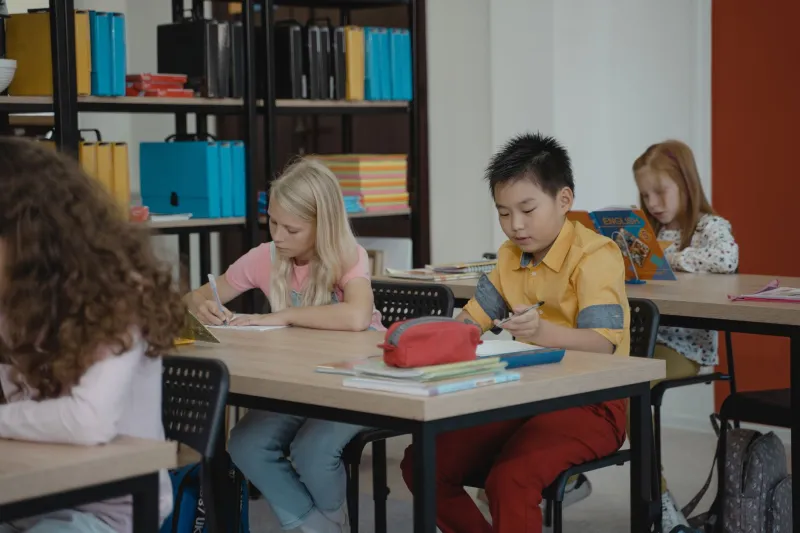
When Year 4 pupil Marcus sits before a blank page, his pencil hovering uncertainly above the paper, his teacher Mrs Phillips recognises the familiar signs of writing anxiety. But Marcus isn't struggling with spelling or handwriting – he's fluent in both. His challenge runs deeper: he simply cannot organise his thoughts coherently enough to begin. The ideas swirl in his mind, but without the oral rehearsal skills to structure and refine them, they remain frustratingly inaccessible.
 Photo: Mrs Phillips, via 2.bp.blogspot.com
 Photo: Marcus, via images.squarespace-cdn.com
Marcus represents thousands of KS2 pupils whose writing difficulties mask a more fundamental issue: underdeveloped oracy skills. Research increasingly demonstrates that speaking and writing are not separate competencies but interconnected processes, with oral language serving as the foundation upon which written expression builds.
The Hidden Connection Between Talk and Text
The relationship between speaking and writing extends far beyond simple transcription. When pupils struggle to express ideas orally, they inevitably encounter greater challenges translating those same ideas into written form. Conversely, pupils who can articulate thoughts clearly in speech possess crucial building blocks for successful writing.
Neurological research reveals that speaking and writing activate overlapping brain regions responsible for language organisation, vocabulary selection, and audience awareness. This biological connection explains why pupils who receive systematic oracy instruction often demonstrate dramatic improvements in written communication without direct writing intervention.
Yet many KS2 classrooms operate under the assumption that writing skills develop independently of speaking abilities. Teachers focus intensively on transcription skills, text structures, and written vocabulary whilst overlooking the oral foundations that make sophisticated writing possible.
Identifying the Oracy-Writing Gap
Recognising pupils whose writing struggles stem from oracy limitations requires careful observation of both speaking and writing behaviours. Key indicators include:
Reluctance to participate in class discussions despite obvious engagement with learning content. These pupils often possess strong ideas but lack confidence to express them publicly.
Difficulty organising thoughts during independent writing tasks, particularly evident in planning stages where pupils cannot articulate what they intend to write.
Strong performance in structured talk activities contrasted with weaker outcomes in independent writing, suggesting that scaffolded oral expression could bridge the gap to written success.
Preference for collaborative work where they can contribute ideas without taking primary responsibility for expression, indicating potential rather than inability.
These patterns suggest that targeted oracy interventions could unlock significant writing potential.
Strategic Talk Partnerships: The Foundation Strategy
The most powerful oracy intervention requires minimal preparation yet yields substantial results: strategic talk partnerships. Unlike random pairing, strategic partnerships match pupils based on complementary strengths and shared interests rather than perceived ability levels.
Effective partnerships operate through structured protocols that gradually build confidence and sophistication. Begin with simple "Think-Pair-Share" sequences, but extend thinking time significantly – research suggests optimal processing time of 30-60 seconds rather than the typical 5-10 seconds most teachers allow.
Introduce sentence stems that provide linguistic scaffolding: "I think... because..." "This reminds me of... when..." "I disagree with... because..." These frameworks support pupils who struggle with spontaneous expression whilst maintaining intellectual challenge.
Progress to more sophisticated protocols such as "Agree, Disagree, Build," where pupils must engage substantively with their partner's ideas rather than simply sharing their own thoughts. This develops the analytical thinking essential for strong argumentative writing.
Rehearsal Routines: From Thought to Expression
Many writing difficulties arise during the crucial transition from mental conception to verbal or written expression. Pupils know what they want to communicate but cannot access appropriate language structures to convey their meaning effectively.
Rehearsal routines address this challenge by providing systematic practice in idea organisation and expression. The "Story Spine" technique, adapted from improvisational theatre, offers one powerful approach:
"Once upon a time... Every day... Until one day... Because of that... Because of that... Until finally... Ever since then..."
This framework supports narrative organisation whilst encouraging pupils to articulate causal relationships and consequences – precisely the logical thinking required for strong story writing.
For non-fiction writing, adapt the structure: "The problem was... This mattered because... One solution is... However... A better approach might be... This would work because..."
These rehearsal frameworks should be practised orally before any writing begins, allowing pupils to experiment with language and organisation in a low-stakes environment.
Debate Structures: Building Argumentative Thinking
Argumentative writing challenges many KS2 pupils because it requires simultaneous management of multiple perspectives, evidence evaluation, and logical sequencing. Structured debate activities develop these complex cognitive skills through engaging oral practice.
Begin with simple "This or That" debates using topics connected to curriculum content: "Should schools have uniform?" "Is it better to live in the city or countryside?" "Should zoos exist?"
Provide clear protocols: each side receives preparation time, specific roles (opener, evidence presenter, questioner, closer), and structured response opportunities. This scaffolding enables even reluctant speakers to participate successfully whilst developing sophisticated argumentative thinking.
Progress to more complex formats such as "Devil's Advocate" discussions where pupils must argue positions they don't personally support, or "Evidence Auction" activities where teams bid on different pieces of evidence to support their arguments.
These activities develop crucial skills: perspective-taking, evidence evaluation, logical sequencing, and respectful disagreement – all essential for strong persuasive writing.
Implementation Without Overwhelm
Successful oracy integration requires systematic implementation rather than dramatic classroom overhauls. Begin by auditing current practice: How much genuine discussion occurs daily? What percentage of pupils contribute regularly? How often do pupils rehearse ideas orally before writing?
Start with one consistent routine – perhaps daily talk partnerships during morning registration or strategic thinking time before writing tasks. Establish clear expectations and provide consistent language scaffolds until routines become automatic.
Gradually expand successful practices rather than attempting comprehensive change immediately. Monitor impact through simple observations: Are previously reluctant pupils participating more? Do writing planning conversations become more sophisticated? Are pupils using more varied vocabulary in their written work?
The Ripple Effect of Confident Communication
When pupils develop strong oracy skills, benefits extend far beyond improved writing outcomes. Confident speakers become more engaged learners across all subjects, contribute more effectively to collaborative work, and develop social confidence that supports emotional well-being.
Perhaps most importantly, pupils who can articulate their thinking clearly develop stronger metacognitive awareness – they become conscious of their own learning processes and can communicate their needs more effectively to teachers and peers.
Year 6 teacher Sarah Chen observed this transformation in her previously reluctant writers: "Once they could talk through their ideas confidently, writing became a natural extension rather than a terrifying leap. They stopped seeing writing as a test of their intelligence and started seeing it as a way to share their thinking with others."
Reframing the Challenge
The pupils who struggle most with writing often possess rich inner lives and sophisticated thinking that simply cannot find expression through traditional approaches. By recognising oracy as the bridge between thought and text, teachers can unlock potential that might otherwise remain hidden.
This reframing transforms teacher practice as well as pupil outcomes. Instead of viewing reluctant writers as lacking ability, teachers can identify specific oral language skills that require development and provide targeted support that builds confidence alongside competence.
When we give pupils their voices, we give them access to their own intelligence. The blank page becomes less intimidating when it represents an opportunity to share ideas already rehearsed and refined through purposeful talk.
In classrooms where strategic oracy development supports writing instruction, silence transforms from a barrier into a choice – and that choice belongs to confident young communicators who know their words have power.