What Your Walls Are Saying: Designing a KS2 Classroom That Genuinely Nurtures Reading Culture
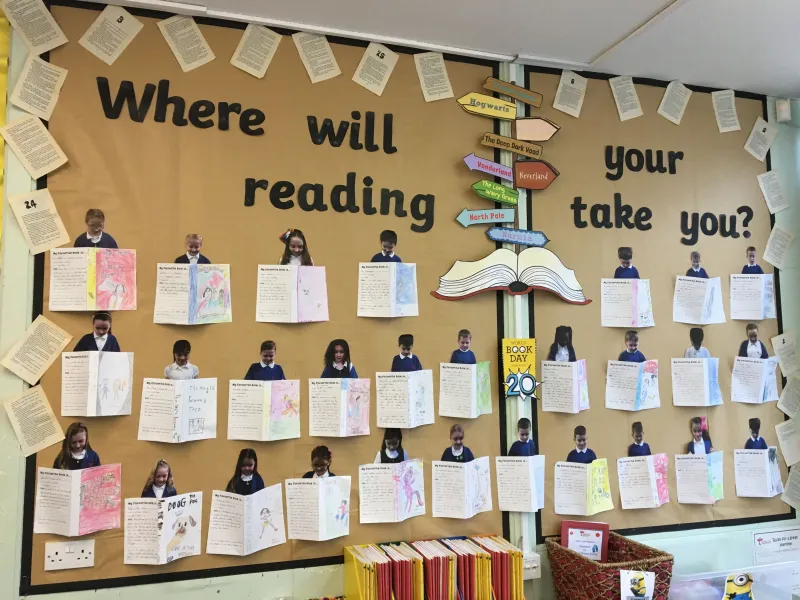
Photo: KS2 primary classroom reading corner book display organised colourful UK school, via i.pinimg.com
The Classroom as Curriculum
Walk into any KS2 classroom and you are, in a sense, reading it. The arrangement of furniture, the organisation of books, the prominence given to pupil work, the presence or absence of reading-related print — all of these communicate something about what is valued in this space and by this teacher. Pupils, who spend hundreds of hours in that environment, absorb those messages continuously, often without conscious awareness.
This is not a peripheral concern. Research into print-rich environments and reader identity formation consistently finds that the physical context in which reading happens shapes pupils' sense of themselves as readers. A classroom that treats books as central, visible, and worthy of attention sends a different signal from one in which books are stored in a box or shelved alphabetically in a corner that nobody visits.
The challenge is that much of the guidance available to teachers on this topic conflates environment with decoration. A beautifully arranged reading corner with fairy lights and a bean bag is pleasant. Whether it actually increases reading engagement is a different question — and the answer is more complicated than it might appear.
What Research Actually Supports
The evidence base for print-rich environments in primary classrooms is substantive. Studies consistently find that classrooms with a higher density of accessible, varied, and well-organised books are associated with greater voluntary reading and stronger reading attainment. The key word is accessible: books that pupils can browse, select, and handle independently, rather than books displayed as objects to be admired from a distance.
Reader identity research adds a further dimension. Work by scholars including Maryanne Wolf and, in the UK context, Teresa Cremin and her colleagues on the Reading Teachers project, emphasises that children develop reading identities partly through seeing reading represented as a valued, adult, and socially recognised activity. This has direct implications for the classroom environment. When a teacher's own reading is visible — through a 'What I'm reading this week' display, through books left on the teacher's desk, through spoken recommendations — it signals that reading is something real adults do for genuine reasons, not merely a school exercise.
 Photo: Maryanne Wolf, via thisisyourbrain.com
Conversely, environments in which reading is represented primarily through assessment-related displays — reading level charts, Accelerated Reader point tallies, comprehension target grids — may inadvertently communicate that reading is fundamentally a performance to be measured rather than an experience to be pursued.
Auditing Your Reading Environment
Before redesigning anything, it is worth conducting a structured audit of your current classroom environment. The following questions provide a useful starting point.
Visibility: Can pupils see books from every area of the room? Are covers facing outward, or are spines the only thing visible? Research suggests that face-out display significantly increases book selection, particularly for less confident readers who are not yet browsing by author or title alone.
Accessibility: Can pupils reach and handle books independently, without requesting permission? Are books available throughout the day, or only during designated reading sessions? The message conveyed by a locked bookcase or a 'do not touch' display is unambiguous.
Diversity: Does the book collection reflect a genuine range of genres, formats, and reading experiences? Non-fiction, poetry, graphic novels, and shorter texts deserve equal shelf space alongside chapter books. A collection dominated by a single format implicitly defines reading more narrowly than it should be.
Status: Where in the room are books positioned? A reading area tucked into a corner behind a partition communicates different priorities from one that occupies a prominent, well-lit central space. The physical geography of the classroom is a status map.
Teacher presence: Is there evidence of the teacher as a reader within the environment? A 'Currently reading' shelf, a recommendation card written by the teacher, or a display of books the class has read together all contribute to the sense that reading is a shared, valued endeavour rather than an instruction to be followed.
Common Practices Worth Reconsidering
Several widely adopted environmental practices deserve critical scrutiny.
Reading level labelling. Colour-coding books by reading level is administratively convenient but carries significant costs. Pupils quickly learn to read the labels and to locate themselves within the hierarchy. This can entrench a fixed mindset about reading ability and discourage pupils from selecting books that interest them but that sit outside their designated band. Where assessment information is genuinely needed, it is better held by the teacher than made visible to pupils through the book collection itself.
Themed displays that prioritise appearance over engagement. A display featuring laminated images of book covers, surrounded by decorative bunting, is visually appealing. It is also, from a pupil's perspective, entirely passive. The same wall space used to display brief, handwritten pupil recommendations — 'I loved this because...' — creates an interactive environment in which peers become trusted guides. Pupil-authored content consistently outperforms teacher-produced display in terms of genuine engagement.
The single reading corner model. Designating one corner of the room as 'the reading area' and leaving the rest of the room reading-neutral misses an opportunity. Reading-related print — interesting words, quotations from texts the class has shared, questions worth thinking about — distributed throughout the room reinforces the message that reading and language permeate everything, not just one designated zone.
Practical, Low-Cost Changes With Real Impact
Environmental redesign does not require a significant budget. The following changes are achievable within most state primary school constraints and have clear rationale behind them.
Rotate face-out displays regularly. A fortnightly change to the face-out books in your collection costs nothing but time and keeps the visual environment fresh. Teachers who link rotations to curriculum topics, seasons, or author birthdays find that pupils notice and respond to the changes.
Create a recommendation wall. Provide pupils with small cards (index cards work well) on which to write a title, a one-sentence recommendation, and their name. Display these prominently. Replenish them throughout the year. The cumulative effect is a reading community in which pupils' voices carry genuine authority.
Make the teacher's reading visible. A small shelf or windowsill dedicated to what the teacher is currently reading — with a brief handwritten note explaining why — costs nothing and models the reading life that teachers want pupils to emulate.
Introduce a 'Books We've Shared' display. As the class reads together across the year, building a visible record of shared texts creates a collective reading history. This is particularly powerful for reader identity: it tells pupils that this class has a reading story, and that they are part of it.
Audit for gaps, not just for quantity. A large collection dominated by one genre or format may feel impressive but serve a narrower range of readers than a smaller, more deliberately curated one. A focused audit asking 'who is not represented here?' is more useful than one asking 'how many books do we have?'
Environment as Invitation
The most effective reading environments in KS2 classrooms are not the most elaborate or the most expensively resourced. They are the ones that communicate, clearly and consistently, that reading matters here — that books are central, that readers are valued, and that the adults in the room are genuinely part of the reading community they are trying to build.
Getting the environment right will not, on its own, create readers. But getting it wrong will quietly undermine every other effort. The walls of a classroom are always speaking. The question is whether they are saying something worth hearing.