Two Heads, One Text: Harnessing Strategic Paired Reading to Deepen Comprehension in Years 3–6

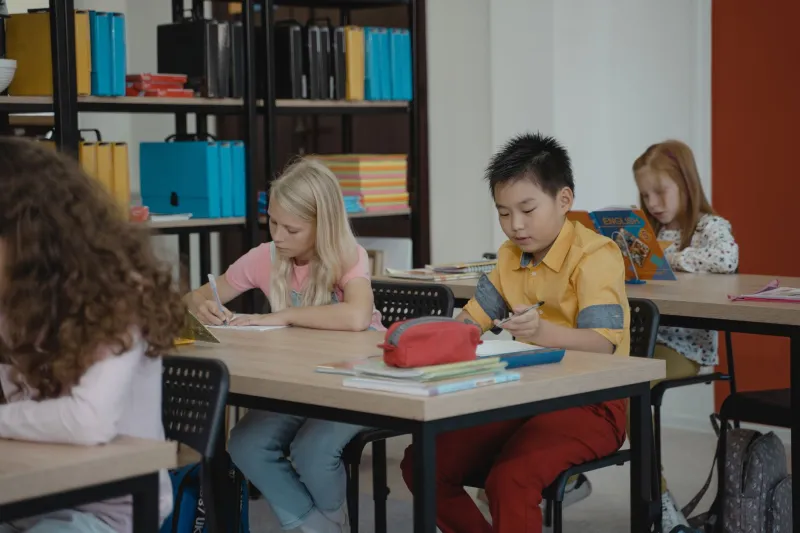
Photo: Thomas Nugent, CC BY-SA 2.0, via Wikimedia Commons
Why Paired Reading Deserves a Second Look
Ask most primary teachers about paired reading and they will likely picture two children sitting side by side, one pointing at words while the other listens. It is a familiar image — and, unfortunately, one that undersells what structured partner reading can genuinely achieve. When paired reading is designed thoughtfully, with deliberate partner selection, scaffolded discussion prompts, and clear role accountability, it becomes something considerably more powerful than an informal classroom arrangement.
The research base is persuasive. Studies consistently show that well-implemented paired reading programmes produce meaningful gains in both fluency and reading comprehension, often in relatively short periods of sustained practice. Crucially, these gains are not limited to the less confident reader in the partnership. The more able reader also benefits — consolidating understanding, developing the language of explanation, and building the kind of metacognitive awareness that underpins deeper literary analysis. For KS2 teachers working within the constraints of limited timetable space and stretched resources, this dual benefit matters enormously.
Choosing Partners With Purpose
The single most important decision in any paired reading programme is how partners are matched. Casual or random pairing frequently results in one child dominating while the other disengages. Effective teacher-facilitated pairing typically places readers approximately one to two reading levels apart — close enough for genuine collaboration, but with sufficient difference to create a natural dynamic of support and challenge.
This does not mean simply pairing the strongest reader with the weakest. Such pairings can inadvertently reinforce unhelpful hierarchies and leave the more able reader unstimulated. Instead, consider constructing a reading continuum across your class and pairing children from adjacent bands. A Year 5 pupil reading confidently at age-expected levels, for instance, might be paired with a pupil who reads fluently but struggles with inference — a combination that creates productive discussion without creating an obvious tutor-and-tutee dynamic.
It is also worth revisiting pairings every half-term. Children develop at different rates, relationships shift, and a pairing that worked well in October may have run its natural course by January.
Defining Roles and Managing Transitions
One of the most common reasons paired reading programmes lose momentum is a lack of clarity about roles. Children benefit from understanding what each role requires of them, and from practising transitions between those roles with explicit teacher guidance.
In a basic paired reading structure, one partner acts as the 'reader' while the other serves as the 'listener and questioner'. The reader reads aloud a short section of text — typically a paragraph or two — while the listener follows along silently. The listener then poses a prepared question or makes a prompted observation before roles switch. This rotation keeps both children actively engaged and prevents the session from becoming a passive exercise for either party.
For younger KS2 pupils in Years 3 and 4, role cards can be invaluable. A simple laminated card listing three or four sentence starters — 'I noticed that...', 'I wonder why...', 'This part made me think of...' — gives the listener a concrete task and models the language of literary discussion. As pupils move into Years 5 and 6, these prompts can become more sophisticated, inviting comparisons between texts, analysis of authorial intent, or evaluation of narrative structure.
Discussion Prompts That Drive Deeper Thinking
The quality of paired reading discussions is directly proportional to the quality of the questions children are asked to explore. Generic prompts such as 'What happened?' or 'Did you like it?' rarely push thinking beyond surface recall. Strategic prompts, by contrast, direct children towards the kinds of inferential and evaluative thinking that the KS2 curriculum demands.
Consider organising prompts into three tiers. The first tier addresses literal comprehension: what happened, who was involved, where the scene was set. The second tier requires inference: why a character behaved as they did, what a particular phrase suggests about their feelings, how the author has created a specific effect. The third tier invites evaluation and connection: whether the pupil agrees with a character's decision, how this text compares with others they have read, what the author might have wanted the reader to feel.
Rotating through these tiers within a single session ensures that paired reading encompasses the full range of comprehension skills, rather than defaulting to straightforward retelling.
Accountability Tools That Sustain Engagement
Without structured accountability, paired reading sessions can drift into social conversations or, conversely, into silent parallel reading. Simple tools help maintain focus without creating an atmosphere of surveillance.
A paired reading log — a shared notebook or printed sheet — gives children a place to record the questions they discussed, the vocabulary they encountered, and any connections they made between the text and their own experience. These logs serve a dual purpose: they keep children on task during sessions and provide the teacher with a rich, ongoing record of reading development that can inform planning and assessment.
Periodic whole-class 'reading conferences', in which pairs briefly share an insight or question from their recent reading, also help sustain motivation. When children know their thinking will be heard by the class, they invest more carefully in the quality of their discussions.
Measuring What Matters
Teachers implementing paired reading programmes often ask how to demonstrate impact beyond anecdotal observation. A straightforward pre-and-post assessment using a standardised reading comprehension task — administered before the programme begins and again after six to eight weeks — provides a baseline comparison. Tracking fluency through timed reading passages at the start and end of the programme adds a further measurable dimension.
Beyond formal measurement, the most telling indicators of a successful paired reading programme are often qualitative: a child who previously avoided reading choosing to continue a paired text independently; a pupil who rarely contributed to class discussions beginning to use the language of inference naturally; two children who initially struggled to collaborate working with evident mutual respect and shared purpose.
These outcomes — empathy, communication, intellectual confidence — extend well beyond literacy. They are, in many ways, the deeper purpose of reading education itself.