Cutting the Safety Net: Scaffolding KS2 Pupils Towards Confident, Model-Free Writing
A Classroom Dilemma
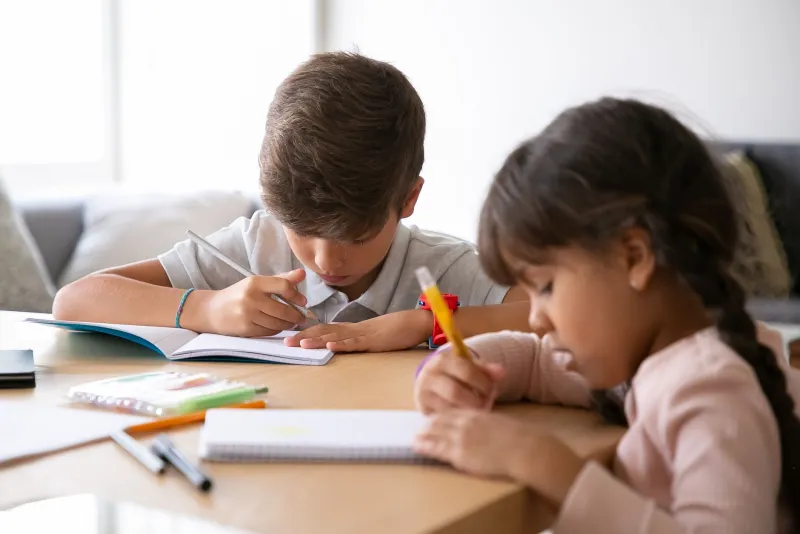
Ask a group of Year 5 pupils to write a setting description after studying a richly crafted extract from a published author, and the results are often impressive. Remove the extract, ask the same pupils to write freely from their own imagination, and something shifts. Pencils hover. Eyes drift. Hands go up with questions that are really requests for reassurance: 'What should I write about?' 'How long does it need to be?' 'Can I use the same structure as the example?'
This dependency is not a sign of laziness or limited ability. It is, in many cases, an unintended consequence of the very pedagogical approaches that have been most celebrated in KS2 writing instruction. The widespread adoption of exemplar texts, mentor sentences, and modelled writing has transformed the quality of supported composition in many schools—but it has also, in some classrooms, created a generation of pupils who are skilled imitators and uncertain originators.
The challenge for teachers is not to abandon models—they remain genuinely valuable—but to design a deliberate pathway from supported to independent composition.
Understanding the Dependency
Before addressing the problem pedagogically, it is worth understanding it psychologically. Writing without a model is cognitively demanding in ways that are easy to underestimate. When a pupil writes with an exemplar in front of them, a significant portion of the compositional burden is already resolved: the genre conventions are visible, the vocabulary register is modelled, the structural architecture is available for reference. The pupil's cognitive resources can be directed towards craft—towards choosing a more precise word, varying a sentence opening, or sharpening an image.
Without a model, all of those decisions must be generated from scratch. For many KS2 pupils, this is genuinely overwhelming. The blank page is not simply an absence of words; it is an absence of direction, permission, and precedent. Pupils who have been trained, however implicitly, to look outward for these things will struggle to find them inward.
There is also an emotional dimension. Writing is an act of self-exposure. When a pupil imitates a model, any perceived failure can be attributed to the gap between their attempt and the exemplar. When a pupil writes from their own imagination, failure feels more personal. The stakes feel higher. This is why the removal of models often triggers not just cognitive difficulty but visible anxiety.
Rethinking the Scaffolding Sequence
The solution is not to withhold models earlier or more abruptly, but to redesign the scaffolding sequence so that it explicitly prepares pupils for independence rather than indefinitely sustaining dependency.
Consider the difference between two approaches. In the first, pupils study a model, identify its features, practise those features in imitation, and then write independently. In the second, pupils study a model, identify its features, begin to abstract those features as transferable principles, practise applying those principles across varied contexts, and only then write independently. The second approach builds metacognitive awareness—an understanding of why a technique works, not just what it looks like—that pupils can carry into unsupported writing.
This distinction matters enormously. A pupil who has learned that a particular story opens with a character in motion has learned a single technique. A pupil who has understood that opening with action creates immediate engagement has acquired a principle they can apply independently, whether they are writing a mystery, a diary entry, or a persuasive speech.
Practical Strategies for Building Independent Composition
Teach Techniques, Not Templates
When analysing exemplar texts, resist the impulse to reduce them to checklists or structural frames that pupils fill in. Instead, name the technique at work and invite discussion of its effect. 'The author begins with a question. Why might that draw a reader in? Where else have you seen this technique? Could you use it in a different genre?' This kind of questioning repositions the model as a source of transferable craft knowledge rather than a blueprint for replication.
Introduce 'Principle Banks' Rather Than Word Banks
Word banks and vocabulary displays are fixtures in many KS2 classrooms, and they serve a genuine purpose. However, for the purpose of building independence, consider supplementing them with 'principle banks'—displays or reference cards that articulate writing principles in pupil-friendly language. Examples might include: 'Show, don't tell—use action and detail instead of naming the emotion' or 'Vary your sentence length—short sentences create tension.' These resources support pupils without supplying the content of their writing, encouraging them to make their own decisions within a principled framework.
Use Incremental Removal of Support
Rather than moving abruptly from fully modelled writing to entirely independent composition, design a gradual release sequence. Begin with the model present and visible. Then ask pupils to write with the model turned face down, consulting it only if genuinely necessary. Then ask them to write without the model but with their own notes about the techniques they observed. Finally, ask them to write with only the principle bank. Each stage incrementally reduces external support while building the pupil's internal resources.
Cultivate a Writing Identity
Pupils who think of themselves as writers are more likely to take compositional risks than those who see writing as a school task to be completed correctly. Invest time in helping pupils develop a sense of their own authorial preferences and tendencies. What kinds of sentences do they enjoy writing? What topics genuinely interest them? What techniques feel natural to them? Regular low-stakes writing—journals, quick writes, response to images or music—builds this self-knowledge without the pressure of assessed outcomes.
Normalise the Difficulty of Starting
Many pupils interpret the struggle to begin as evidence that they cannot write. Teachers can disrupt this narrative by making the difficulty of composition explicit and universal. Share examples of published authors describing their own struggles with the blank page. Introduce brief 'starter rituals'—a sentence stem, a single image, a remembered smell—that lower the threshold for beginning without determining the direction of the writing. The aim is not to make starting easy, but to make the difficulty of starting feel normal and surmountable.
Assessing for Independence
If independent writing is a genuine instructional goal, it must be assessed as such. Teachers should create regular opportunities for pupils to write without access to models or shared planning, and should use these moments diagnostically rather than punitively. What decisions is the pupil making confidently? Where are they hesitating? What is the gap between their supported and unsupported writing? These observations should inform subsequent teaching, not merely generate marks.
Writing as a Self-Sustaining Skill
The ultimate goal of writing instruction is not a pupil who can produce excellent work when scaffolded, but a pupil who can face an unfamiliar task, draw on an internalised repertoire of knowledge and technique, and compose with confidence and purpose. That goal requires teachers to deliberately and systematically build the bridge between imitation and origination—to honour the value of models while never allowing them to become the ceiling of a pupil's ambition.