Rethinking the Red Pen: How Teaching Revision as Thinking Transforms KS2 Writing
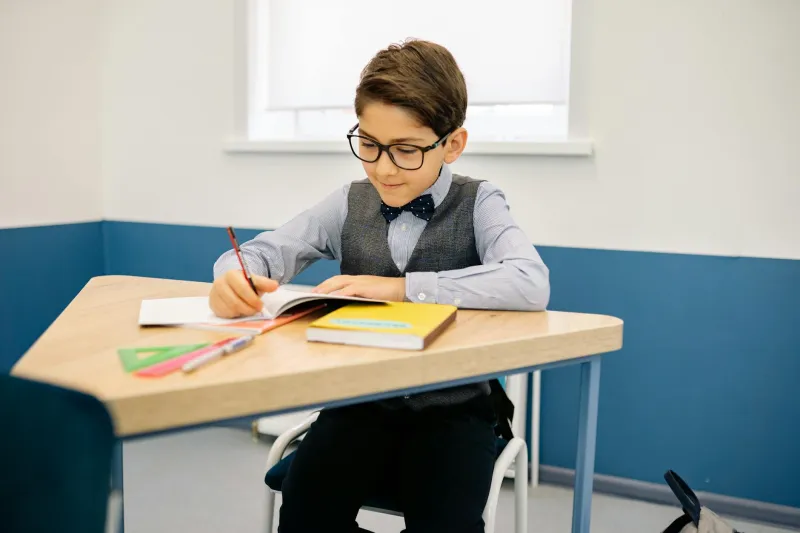
Walk into any Year 5 classroom during writing time and you'll likely witness a familiar scene: children hunched over their work with coloured pens, dutifully correcting spelling mistakes and adding missing capital letters. Teachers praise this 'revision' work, yet the fundamental ideas, structure, and voice of their writing remain unchanged. This widespread confusion between revision and editing represents one of the most significant barriers to writing development in Key Stage 2.
The Misconception That's Holding Back Progress
Across UK primary schools, the terms 'revision' and 'editing' have become dangerously interchangeable. Teachers often direct pupils to 'revise' their work when what they actually mean is proofread for surface errors. This linguistic muddle has profound implications for how children understand the writing process.
True revision—from the Latin 'revisere', meaning 'to see again'—involves fundamental reconsideration of ideas, organisation, and expression. It's about asking: Does this paragraph belong here? Have I explained my thinking clearly? Will my reader understand my argument? These are cognitive processes that require sustained thinking, not mechanical correction.
Editing, by contrast, focuses on the technical presentation: spelling, punctuation, and grammar. Whilst important, editing should never be mistaken for the deeper work of revision.
Why This Confusion Damages Writing Development
When children learn to equate revision with error-hunting, several harmful patterns emerge. First, they begin to view their initial drafts as fundamentally flawed rather than starting points for exploration. This breeds writing anxiety and perfectionism that can persist throughout their education.
Second, pupils develop a surface-level understanding of 'good writing' that prioritises correctness over communication. They may produce technically accurate but bland, formulaic pieces that lack voice, originality, or depth.
Most significantly, children miss opportunities to engage in the kind of recursive thinking that develops both writing skills and broader cognitive abilities. When revision is reduced to proofreading, we rob pupils of chances to wrestle with complex ideas, reorganise their thinking, and discover new insights through the writing process.
Research-Backed Approaches to Authentic Revision
Effective revision instruction begins with helping children understand that professional writers rarely get their ideas right the first time. Share examples of published authors' drafts, showing how even experienced writers move paragraphs, delete sections, and completely reframe their arguments.
Introduce revision as 're-seeing' through specific questioning strategies. Rather than asking 'Have you checked your spelling?', prompt deeper thinking with questions like: 'What's the most important thing you want your reader to understand?' or 'If you could only keep three sentences from this paragraph, which would they be?'
Implement structured revision protocols that separate thinking from mechanics. For instance, dedicate specific sessions to content revision where spelling and punctuation errors are explicitly ignored. Use different coloured paper or digital tools to signal that this is 'thinking time', not 'fixing time'.
Practical Strategies for the KS2 Classroom
Create revision partnerships where pupils read their work aloud to peers, focusing on clarity and flow rather than technical errors. Train children to ask each other content-focused questions: 'What confused you?' 'Where did you want more information?' 'Which part was most interesting?'
Use revision checklists that prioritise big-picture concerns over surface features. A Year 4 checklist might include: 'Does my opening grab the reader's attention?' and 'Have I used specific examples?' before moving to technical considerations.
Introduce 'revision rounds' where children focus on one element at a time—perhaps organisation in round one, voice in round two, and word choice in round three. This prevents overwhelm whilst building systematic revision habits.
The Role of Teacher Modelling
Perhaps most importantly, teachers must model authentic revision thinking. Share your own writing struggles, demonstrating how you might restructure a difficult paragraph or search for a more precise word. Think aloud as you consider whether an example supports your main point or if your conclusion ties back to your introduction.
This transparency demystifies the revision process and shows pupils that uncertainty and multiple drafts are normal parts of writing, not signs of failure.
Moving Forward: A Balanced Approach
This isn't to suggest that editing skills are unimportant—accurate spelling, punctuation, and grammar remain essential components of effective communication. Rather, the goal is to help children understand that revision and editing serve different purposes and require different kinds of thinking.
By clearly distinguishing between these processes, we can help KS2 pupils develop into writers who think deeply about their ideas, consider their readers' needs, and view writing as a powerful tool for learning and communication rather than simply a test of technical accuracy.
The red pen will always have its place in primary classrooms, but it shouldn't be the first tool we reach for when supporting young writers. True writing growth happens when children learn to see their work with fresh eyes, to question their choices, and to embrace revision as an opportunity for discovery rather than merely correction.